GOOGL watch $313-316: Major Resistance zone could mark a TOPGOOGL has been flying high on the success of Gemini. Just hit a major resistance zone at $313.21-316.33 Looking for a Dip-to-Fib like $294.08 or below to buy.by EuroMotif6
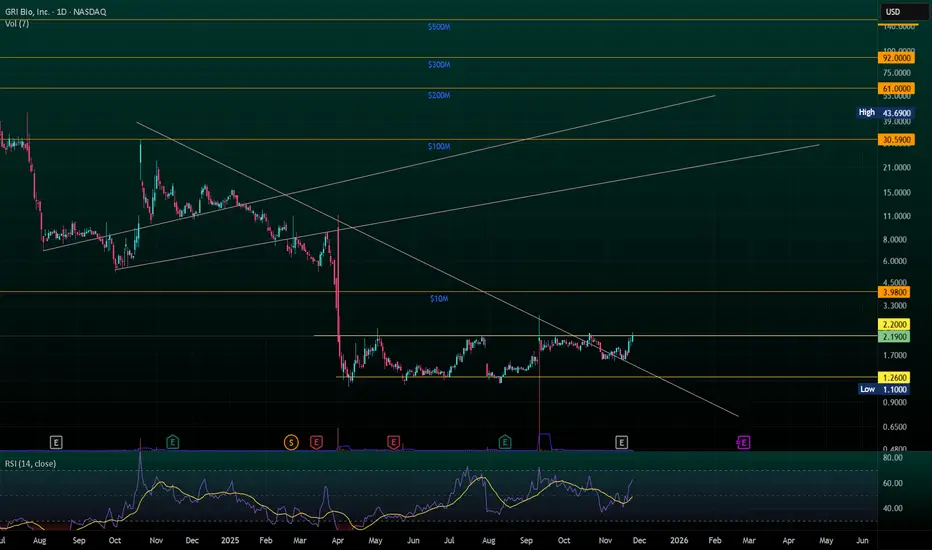
$GRI tap tap tapping $2.2 resistanceNASDAQ:GRI will release topline 12-week study data this week. All indications are that data will be positive. The price continues to test $2.2 resistance. This will be broken soon. While all price movements are relative and unique, other companies with failed IPF trials lost ~$300M in market cap upon announcement. Others with successful trails have gained billions. GRI is worth approximately $6M today. Lots of room for upward valuation.Longby nothximgood1
SharpLink & the Rise of Crypto Treasury CompaniesA quiet but profound shift is taking hold in public markets: companies like SharpLink NASDAQ:SBET , MicroStrategy NASDAQ:MSTR , and a fast-growing list of others are no longer just operating businesses; they are transforming into full-fledged on-chain corporate treasuries.They have virtually no direct competitors. Their true goal isn’t to outdo one another, but to accumulate massive Ethereum reserves, lock them into staking and restaking protocols, earn high-yield passive income, and simultaneously lay the foundation for an entirely new corporate finance stack. From Proof-of-Work to Proof-of-Stake and Restaking Bitcoin remains tied to energy-intensive mining. Ethereum, Solana, TON, and nearly every major Layer-1 have moved to Proof-of-Stake, where token holders secure the network and earn rewards. Standard staking yields ~3–5 % annually. Restaking protocols like EigenLayer reuse the same locked ETH to secure additional networks, pushing effective yields into the 8–15 %+ range while keeping the assets liquid through derivatives. The New Corporate Treasury Model SharpLink and its peers are building treasuries that live entirely on-chain. They raise U.S. dollars through equity offerings or low-cost convertible debt, immediately convert those dollars into Ethereum, and lock the tokens into staking and restaking layers. On October 28, SharpLink announced it would deploy another $200 million into restaking protocols. Today, the company’s primary revenue and profit driver is no longer its legacy operations; it’s staking and restaking rewards on its Ethereum holdings. In its most recent third quarter, SharpLink reported over $100 million in net income almost exclusively from these activities. Why the Model Is Spreading So Fast Capital can be raised at 3–4 % cost and deployed into strategies yielding significantly more, with virtually no duration mismatch. Every new corporate treasury that stakes its ETH reduces circulating supply and steadily tames realized volatility. By 2026–2027, traditional giants like JPMorgan and BlackRock are widely expected to accept liquid staking tokens (stETH and equivalents) as high-grade collateral alongside BTC and ETH. Once that happens, public companies will be able to earn double-digit risk-adjusted returns on their balance sheets without ever losing access to the underlying assets. The Bigger Picture These companies aren’t competing; they are collectively building the rails of tomorrow’s corporate finance system, one staked token at a time. 5-10 years, possibly much sooner - and holding staked Ethereum on a public company’s balance sheet will feel as normal as holding cash or short-term Treasuries does today. SharpLink and the handful of aggressive first-movers are not just speculating on price. They are positioning themselves as the foundational infrastructure of the next financial era, when corporate balance sheets migrate en masse onto the blockchain. Disclosure : Cryptocurrency investments remain highly volatile and unregulated in many jurisdictions. Always conduct your own research and invest only what you can afford to lose.Longby juliakhandoshko110
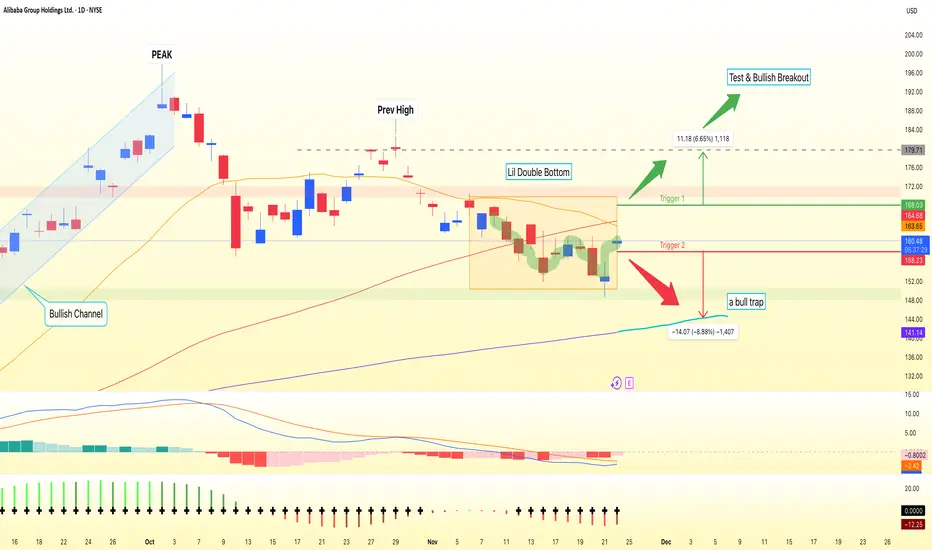
BABA Breakout WatchBABA’s daily chart has shifted from a strong August–October rally into a corrective phase, with price now around 160 and printing a clear sequence of lower highs and lows. Price sits below the MA20 and MA60 but still above the rising MA120 near 141. This keeps the broader uptrend technically alive while short-term pressure remains bearish. A potential Double Bottom is developing in the 150–153 demand zone, with a strong bullish reaction from the second trough and a neckline around 168. For bulls, the key is clearing the moving-average “ceiling” first. A daily close above 165 would show that buyers are absorbing supply at resistance and open the path toward a retest of the 168 neckline. A confirmed daily close above 168 would validate the Double Bottom and put 175–179 initially, and then 184, on the radar as measured-move targets. For this bullish idea, a sustained move back below 158, and especially a break under 150, would be a clear invalidation and shift focus back toward 148–144 near the MA120. If price instead loses 158 on a daily close without ever reclaiming 165, the bounce looks more like a relief rally inside the downtrend, with sellers likely pressing for a deeper test of 150 and potentially 144. Until either 165 breaks topside or 158 fails, expect noisy consolidation between support at 150 and resistance near 165. This is a study, not financial advice. Manage risk and invalidations. Thought of the Day 💡: Let the level confirm the idea, not the other way around. ------------------------ Thanks for your support! If you found this idea helpful or learned something new, drop a like 👍 and leave a comment, I’d love to hear your thoughts!Longby bbqgio5
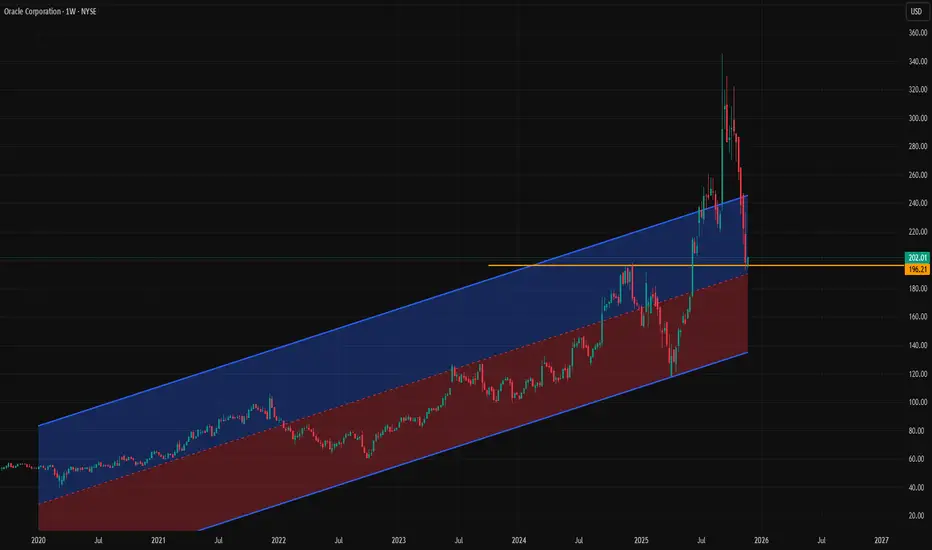
Oracle LongOracle is at the regression line from the start of 2020 (covid to date) and retesting the previous top as a support. If market won't go into full panic it might be a good place to enter.Longby orancapital1
JKHY Breakout: Downtrend Crushed — Now Watching for the PullbackHello Everyone and Followers, This is the final one from my side. I found JKHY in my scans and i would like to share details with you. Jack Henry & Associates (JKHY) has just delivered a clean breakout of the long-term downward trendline, a major structural shift after months of lower highs and persistent selling pressure. This is typically the first sign that bearish momentum is exhausted. What stands out: Price pushed through the yellow downtrend line with strong candle follow-through. It broke the 100 MA (red) and re-test this level and finally pushed through the downtrend. It’s now fighting with the 200 MA (blue) — a classic “confirmation zone” for trend reversals. The move from the 157.9 zone back above 166.5 and now testing 173.4 shows increasing strength in each leg. 🔹 Outlook The breakout signals a potential trend reversal — but those usually don't go straight up. A pullback toward the breakout zone (166–168) would be perfectly normal and actually healthier for building a sustainable uptrend. If price holds this zone and flips it into support, continuation toward 180.00 - 181.00 becomes more likely. If the pullback fails and price loses 166, momentum cools again, and we could see a retest of the mid-150s. 🔹 My Plan I’m keeping an eye on: Pullback into 166–168: This is my preferred entry zone if the structure holds and the bounce confirms. Continuation breakout above 173.4: If it breaks this level with strength, momentum traders may chase toward 180+. Invalidation: A close below 157.9 would weaken the reversal setup. Clear trend shift, strong momentum signal — now patience is the edge. This is just my thinking and it is not invesment suggestion , please do not make any decision with my anaylsis. Have a lovelly Sunday to all and Good Start a Week. #JKHY # SPX500 #NASDAQ Longby streak35Updated 1
SE in BUY ZONEMy trading plan is very simple. I buy or sell when at either of these events happen: * Price tags the top or bottom of parallel channel zones * Money flow volume spikes beyond it's Bollinger Bands So... Here's why I'm picking this symbol to do the thing. Price in buying zone at bottom of channels Money flow momentum is negative and under bottom of Bollinger Band Entry at $132.25 Target is upper channel around $147Longby chancethepugUpdated 0
HPQ – Earnings Setup for 25 Nov Hello Everyone and Followers, This is the last one from my side for this week and i will try to update my posting next week. HPQ will release their report on Tuesday as well. HPQ has been under heavy selling pressure ahead of earnings, dropping into the 23.96 area after breaking several major trendlines. Price is now bouncing from oversold conditions, but the structure is still fragile. The chart is stuck between the long-term upward trendline and the newly formed descending resistance line — a classic squeeze before earnings. HPQ is currently below all major MAs — a bearish configuration unless earnings flip sentiment. 🔹 Trend Structure HPQ broke below its ascending yellow trendline in early November and is now trading inside a clear descending wedge/channel. A bounce is forming, but it’s happening inside a downtrend. The first real challenge is the 24.94 → 27.00 zone. 🔹 Scenarios Bullish Case Break above 24.94 and hold Move into 27.00 - 27.10 Bigger upside toward 28.80 → 30.00 only on strong earnings Bearish Case Reject at 24.94 Fall back to 22.50 → 21.30 If earnings miss, 19.20 becomes realistic 🔹 Outlook HPQ is recovering slightly from oversold conditions but still trades firmly under bearish pressure. Earnings on the 25th will decide whether this is a trend reversal or just a relief bounce inside a bigger downtrend. 🔹 My Plan Above 24.94: I’ll watch for a move toward 27.00 and monitor volume. Below 23: I’ll stay cautious — downside toward 21.30 or even 19.20 remains open. Waiting for earnings reaction before making any aggressive moves. This is just my thinking and it is not invesment suggestion , please do not make any decision with my anaylsis. Have a lovelly Sunday to all and Good Start a Week. #HP #HPQ # SPX500 #NASDAQby streak35Updated 2
DELL - Another Earnings SetupHello Everyone, Followers, DELL is another one that will release their financial reports on Tuesday next week. Here is my view on it. DELL is coming into earnings with a sharp pullback after the big run earlier this quarter. Price dropped from the 160s and is now trying to stabilize around 122.51, right on a key Fib level and right above the long-term yellow trendline support. DELL currently trades below all three major MAs (20-50-100) and just above of 200 MA— earnings will be the catalyst to determine whether this breakdown reverses or accelerates. 🔹 Trend Structure DELL has broken below the ascending trendline for the first time since summer, but price is sitting on the lower trendline of the longer-term channel. This is a natural reaction area. A close back above 124.40 - 124.50 may indicate a potential reversal. 🔹 Scenarios Bullish Case Reclaim 124.4 Push toward 132 → 141.50 - 142.00 Strong earnings could target 158.00, but only if volume confirms Bearish Case Reject at 124.4 Fall back toward 110 → 103 Break of 103 opens a deeper correction 🔹 Outlook DELL is in a technical decision zone ahead of earnings. Buyers want to defend the long-term trendline, but momentum remains weak and the MA structure is stacked against the bulls. A reclaim above the 124–130 range would be the first real sign of stabilization. 🔹 My Plan Above 124.4: I’ll watch for a bounce toward 130–141.4. Below 120: I’ll stay patient and wait for the 103 area to consider new entries. No chasing here — earnings will decide the direction. If you enjoy and like clean, simple analysis — follow me for more. This is just my thinking and it is not invesment suggestion , please do not make any decision with my anaylsis. Have a lovelly Sunday to all and Good Start a Week. #DELL #SPX500 #Earningsby streak35Updated 1
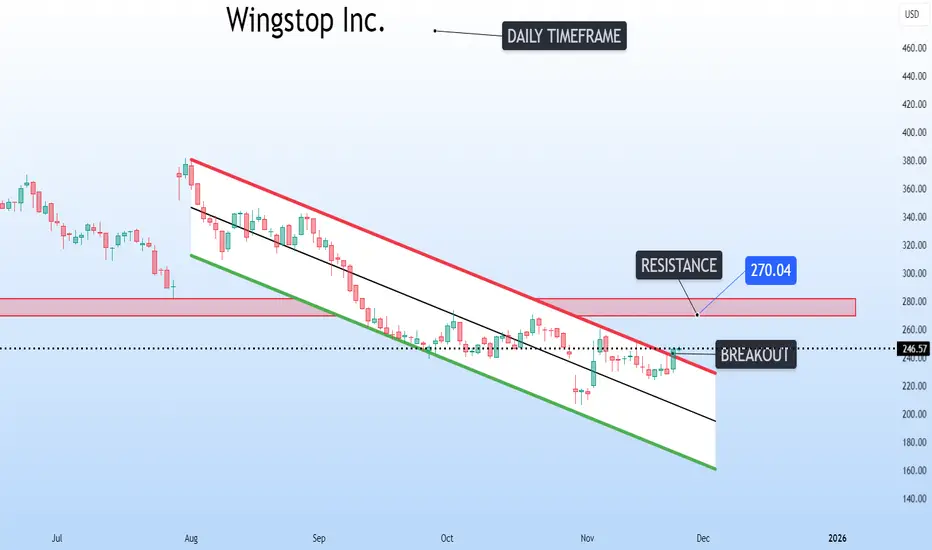
Wingstop Breakout from Descending ChannelWingstop NASDAQ:WING just triggered its first real shift in momentum. After months of drifting inside a clean descending channel, price has now broken out of that structure and is pressing directly into the long-standing downtrend line that’s been capping every rally since August. The real battlefield sits between $𝟮𝟳𝟬 𝗮𝗻𝗱 $𝟮𝟴𝟬. Clear that level, and the downtrend that’s been weighing on this chart for months could finally be done.Longby ledgerdary1
Inverse Heads and Shoulders on the HourlyOPEN has an inverse head and shoulders on the hourl. There is potential for a strong reversal here as long as the general indexes behave. Wait for confirmation of the neckline break. Longby DegenTrades884
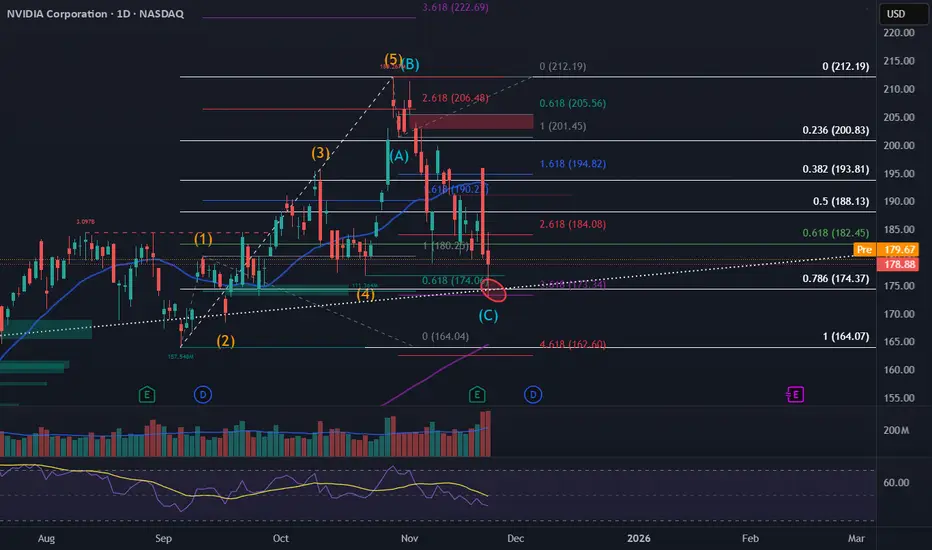
NVDA Corrective Structure Completing? Critical Fib & Trendline CNVIDIA is completing an ABC correction after the recent top. Price is now sitting on a strong support area around 174–177, where multiple Fibonacci levels and a long-term trendline meet. If this zone holds, NVDA may start a new move up toward 182–194. If it breaks below 174, deeper levels like 164 become possible. Watching for a reaction here to confirm the next direction.Longby roimizrahi445
INSP watch $108-109: Double Golden zone may DIP to buy BOTTOM?INSPire has been un-inspiring for a while now. Just spiked into Double Golden at $107.95-109.59 Look for a Dip-to-Fib like $101.71 or $98 green zone. . Previous Analysis that caught the EXACT BOTTOM: by EuroMotif2
BABA Winds Have Shifted - Macro EntryAs always, I try not to publish trades without having a big view of multiple factors so this one is based on a long term view over the next 1-2 years. Macro: I have outlined China's Central Bank (PBoC) liquidity injections (through reverse repo and MLF data) as very seasonal at the bottom pane on the chart. I do NOT believe history or seasonals should dictate future action but it is worth noting the seasonal nature of the PBoC liquidity injections and we are seeing an early rise in total and frequency since June. In fact, a recent print on 8/15 was the biggest spike since the height of 2023. China is also coming out of the rough no tolorence policy during the "pandemic" so some of their stocks are poised for major breakouts. That said, the U.S. M2 money supply is breaking out of a range with global liquidity on the rise heading into central bank easing around the world. No doubt we have some volatility in global liquidity ahead (US debt ceiling to name one) but the general trend is up and to the right over the next 2 years once we get through the vol. Price Action: As I mentioned, the price of this stock has been on a downward trend since Fed Funds rates started moving up in 2021 and has completed the bearish bat making 3 consecutive higher highs since the low in 2023. Looking at Fibonacci the targets are clear but for target 2 I am looking at the massive gap from end of 2021. My first exit before the stop loss would be losing any of the recent higher highs and the S/L is set to under the 2023 low. However, I would rely on the macro section more than price action for the exit. Timeline: I am a 3 month to many year investor not a day trader so this is one I will layer in and buy dips for the next few months. I did take a 5% position at the entry point noted. I do think the next 2-3 years will be net positive for liquidity and assets. Thanks Longby TrainwreckUpdated 10
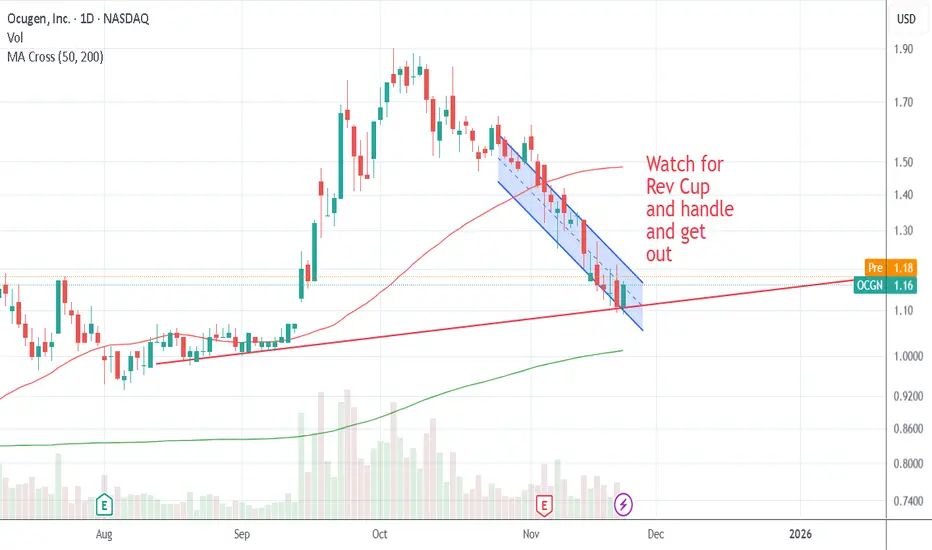
OCGNI think this one is going places. Maybe 5x by next year sometime. In the short term, be careful of the rev cup and handle. Go easy are 1.30 to 1.40 and just keep an eye on it. I think OCGN is one of the best of breed in gene therapy to cure some blindness diseases. Longby Hondo287110
NVO USThe decline in Novo Nordisk shares is not the result of a single factor, but rather the result of a complex set of fundamental issues: weakening financial performance, loss of competitive advantage in key products, and increased strategic risks. While negative data on Eli Lilly's weight loss pill in August 2025 triggered a temporary optimistic rebound in NVO shares, it failed to reverse the overall downward trend caused by the company's deeper structural problems. Now, in order: Operating and Financial Results Sales and operating profit growth forecasts for 2025 have been lowered twice; Q3 2025 results below expectations Operating margin fell to 41.7% from 44.7% (YoY), gross margin decreased to 81.0% from 84.6% Free cash flow declined 11% due to a sharp increase in capital expenditures Competitive pressure: Superiority of Eli Lilly products. Zepbound (Eli Lilly) demonstrates greater effectiveness in weight loss (20.2% vs. 13.7% for Wegovy); Mounjaro overtook Ozempic in diabetes sales. NVO's CagriSema failed to meet expectations in clinical trials. Companies such as Viking Therapeutics, Altimmune, Roche, and Amgen are developing promising anti-obesity drugs, threatening the Novo Nordisk-Eli Lilly duopoly. The company recently agreed to set a "maximum fair price" for Medicare under the Inflation Reduction Act. As a result of the deal, the price of Wegovy for certain patient categories is also expected to drop to $149 per month, compared to the current starting price of $1,349. Such a sharp price reduction will directly impact revenue and profits. Novo Nordisk's share of the US GLP-1 market fell to 43%, while Eli Lilly's grew to 57%. To protect profitability, Maziar's new CEO, Mike Dusdar, initiated stringent cost-cutting measures, including a hiring freeze, layoffs, and a 23.8% reduction in R&D spending. While this may support cash flow in the short term, this strategy raises concerns about long-term innovation. Eight R&D projects were terminated, potentially slowing the market launch of promising next-generation drugs such as CagriSema and oral semaglutide. NVO shares attempted a reversal around $60, but then this figure became a mirror level, and investors sold en masse from this price, which is certainly concerning. The chart shows volumes around $60. Be that as it may, the price is now below $50, and we can see the market trying to catch a low, trying to cling to any level. We're expecting a lower price.Shortby A3MInvestments3
$META: Wave 3 to start soonNASDAQ:META : The bear market of 2021-2022 ended a higher degree 5-wave sequence and started a new 5-wave sequence, which is Wave . Tariff scare completed Waves I and II of . Wave III of started at the bottom. We've had a very aggressive Wave 1 of III and a deep Wave 2 of III. I expect Wave 3 of III to make a new high, reaching 1.618% length of Wave 1.Longby HeadsUp20213
NOKBF — Swing Trade Analysis**NOKBF — Swing Trade Analysis** **1. Overview** * **Price:** 5.93 * **Trend Filter:** Above 200 SMA (5.16). This indicates a long-term bullish bias. * **Setup Type:** **Mean Reversion / Oversold Bounce (Long Setup)**. The extremely low RSI(2) (1.19) and the price being significantly below short-term moving averages strongly suggest an oversold condition ripe for a bounce. **2. Trend Analysis** * Price (5.93) is significantly below EMA20 (6.71) and EMA50 (6.09). * Distance from EMA20: -11.66%, confirming the current price is very stretched to the downside relative to its recent short-term average. * While the long-term trend (above SMA200) is bullish, the short-term trend (Price < EMA50 < EMA20) is bearish, supporting the idea of a potential bounce from oversold levels rather than a continuation of a strong uptrend. **3. Mean Reversion** * **RSI(2): 1.19** - This is an extremely oversold reading, making a mean reversion bounce highly probable. * Down-streak: 0 (This seems contradictory to the RSI(2) but will defer to the strong RSI signal). **4. Key Levels** * Current Price: 5.93 * 14-Day High: 7.07 * 14-Day Low: 6.79 (Current price is significantly below this level, indicating a sharp recent drop) * SMA200: 5.16 (Long-term support) * ATR(14): 0.33 (Useful for stop/target sizing) * ADR(20): 0.15 (Lower than ATR, suggesting recent increased volatility) **5. Volume** * Volume Trend: Volume Rising. If this is rising on down days, it could indicate selling pressure, but in the context of extreme oversold conditions, it might precede a capitulation bounce. **6. Market Risk** * VIX: 23.27. This indicates elevated market volatility and caution should be exercised with position sizing. **7. Trade Plan (Long Setup)** * **Entry:** 5.93 (Current Price) * **Stop:** Using 1.5x ATR below entry to allow for volatility given the VIX. * 1.5 * ATR(14) = 1.5 * 0.33 = 0.495 * Stop = 5.93 - 0.495 = **5.43** * **Target 1 (Nearest Level):** The EMA50, which often acts as resistance during a bounce. * Target 1 = **6.09** (EMA50) * **Target 2 (Extension):** The EMA20, or the prior 14-Day Low which could now act as resistance. * Target 2 = **6.71** (EMA20) * **Position Size:** Adjust for VIX. Given VIX at 23.27, reduce standard position size to mitigate risk due to higher market volatility. **8. Invalidation Conditions** * A break and close below the calculated stop level of **5.43**. * A decisive break below the long-term SMA200 (5.16) would invalidate the overall bullish trend filter. * Continued strong selling pressure on significant volume without any signs of a bounce, indicating the oversold conditions are not leading to an immediate reversal. **9. Risk-to-Reward** * **Risk:** Entry (5.93) - Stop (5.43) = **0.50** per share. * **Reward 1 (to Target 1):** Target 1 (6.09) - Entry (5.93) = **0.16** per share. * **R:R (Target 1): 0.16 / 0.50 = 0.32:1** (This is a very low R:R, suggesting Target 1 is a conservative initial profit-taking level or that the trade is focused on the higher target.) * **Reward 2 (to Target 2):** Target 2 (6.71) - Entry (5.93) = **0.78** per share. * **R:R (Target 2): 0.78 / 0.50 = 1.56:1** (A more acceptable R:R for a swing trade.) **Conclusion:** This plan identifies NOKBF as an oversold mean reversion candidate for a bounce, supported by an extremely low RSI(2) and being significantly below key short-term moving averages, while maintaining a long-term bullish bias above the 200 SMA. The trade requires a tight stop due to potential continued short-term weakness and elevated VIX. The R:R to the first target is low, but improves significantly for the second target."Longby SwingTraderKev3
GeneDx Holdings Corp. (WGS) Advances Genomic DiagnosticsGeneDx Holdings Corp. (WGS) is a leader in genomic testing and rare disease diagnostics, helping physicians identify complex genetic conditions through whole exome and whole genome sequencing. Its platform delivers fast, accurate results that support early diagnosis and more precise treatment plans. GeneDx’s growth is fueled by expanding adoption of genomic medicine, rising demand for rare-disease detection, and its deep database of genetic insights that strengthens clinical outcomes. On the chart, a confirmation bar with increasing volume signals bullish momentum. The price has moved into the momentum zone after breaking above the .236 Fibonacci level. A trailing stop can be placed just below the .236 Fib using the Fibonacci snap tool, helping traders protect gains while staying positioned for potential continued upside.Longby traderspro_charts0
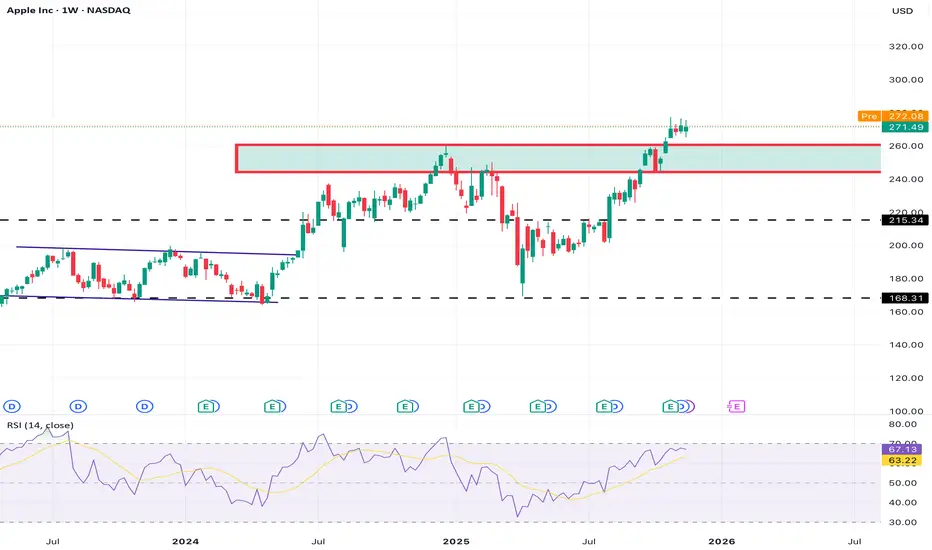
As good as it gets, Apple did its job.We may have a problem houston, Weekly chart gives potential to short. However, dont forget to follow smart money. I added potential support zone. Shortby vgoktas0
Blue Bird Corporation (NASDAQ: $BLBD) Set for Earnings ReportBlue Bird Corporation (NASDAQ: NASDAQ:BLBD ) is schedule to report her earnings results today after market close. The asset has close Friday's trading session up 6% trading within the ceiling of the resistant zone at $60. With the RSI at 65, a little thrust from the bulls will break the ceiling of the $60 resistant as more buyers step in. The stock price has increased by +36.95% in the last 52 weeks. In the last 12 months, Blue Bird had revenue of $1.42 billion and earned $115.89 million in profits. Earnings per share was $3.49. The 6 analysts that cover Blue Bird stock have a consensus rating of "Strong Buy" and an average price target of $63, which forecasts a 17.06% increase in the stock price over the next year. The lowest target is $50 and the highest is $71. Financial Performance In 2024, Blue Bird's revenue was $1.35 billion, an increase of 18.92% compared to the previous year's $1.13 billion. Earnings were $105.55 million, an increase of 343.25%. About BLBD Blue Bird Corporation, together with its subsidiaries, designs, engineers, manufactures, and sells school buses in the United States, Canada, and internationally. The company operates through two segments, Bus and Parts. It offers Type C, Type D, and specialty buses; and alternative power options through its propane powered, gasoline powered, compressed natural gas powered, and electric powered school buses, as well as diesel engines. Longby DEXWireNews5
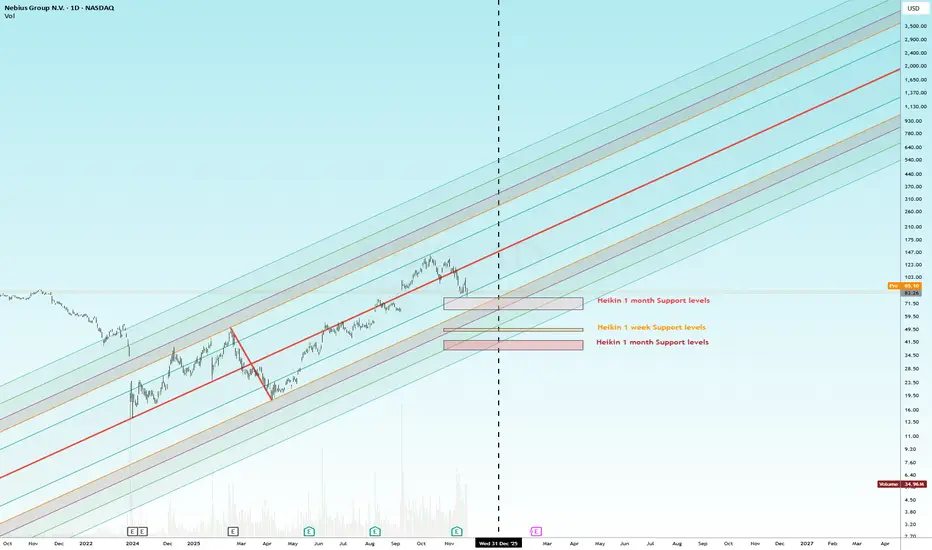
Next support levels for NBISAfter breaking down past week, now we face a very important week for markets, where we have almost a data issued every day. These are the supports for the downside, where the last one means almost a 60% down. If we are able to respect the upper monthly support, the trend can continue up, but also be careful of a possible bear flag that takes up down there.by CryptoPummel1
$HD - Weekly ChartNYSE:HD Weekly Chart Buying dips into the 200-week EMA has been one of the most reliable long-term strategies on Home Depot. For nearly a decade, every major correction into the 200W EMA has offered exceptional entry points, often marking cyclical bottoms before multi-month trends higher. On the current chart: • Price is once again revisiting the 200W EMA, an area that historically acts as dynamic support. • Momentum indicators (Stoch / RSI) are entering oversold territory, aligning with prior reversal zones. • Structure remains intact, with a long-term ascending trendline still supporting the broader bullish cycle. • The stock is pulling back into a high-confluence zone: long-term trendline + EMA200 + historical demand. If buyers step in where they usually do, HD could once again offer a high-probability setup—not financial advice, just pattern recognition. 👉 This stock has now been added to my shortlist.Longby Mike_Trading_0