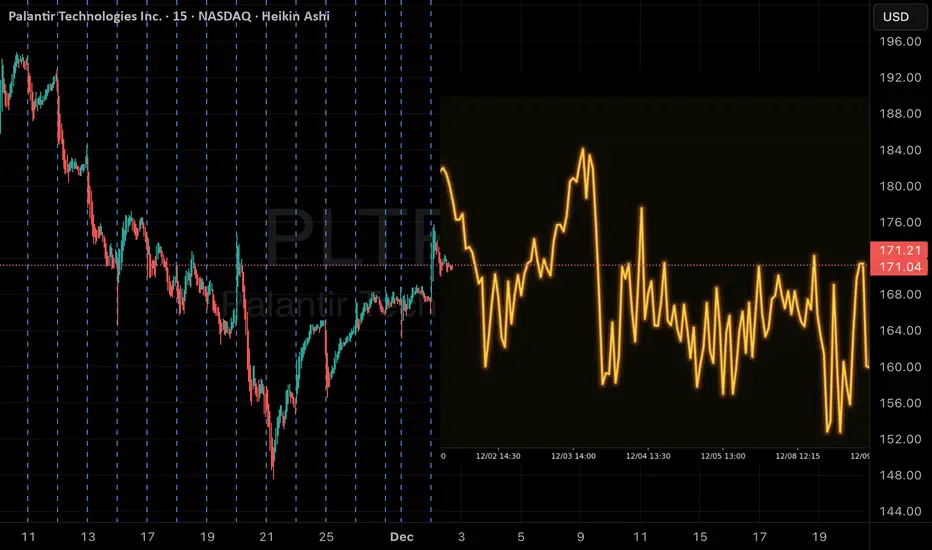
PLTR Swing Trade: Targeting $170 Calls in Mixed Market SignalsPLTR QuantSignals V3 Swing — 2025-12-01
Ticker: PLTR
Current Price: $167.58
Trend: BEARISH (Katy AI) / BUY CALLS (LLM) ⚠️ Conflict
Confidence: 65%
Time Horizon: 18 days (to 2025-12-19)
Trade Signal: BUY CALLS (but Katy AI shows PUT potential, -2.87%)
Entry: $8.30
Target 1: $12.23 (50% gain)
Target 2: $16.30 (100% gain)
Stop Loss: $5.72 (30% loss)
Swing Analysis:
Price at 74.6% of swing range ($163.12–$169.10), suggesting momentum potential for breakout.
Market context: STRONG_BULLISH overall, SPY/QQQ bullish.
Options flow: Neutral, PCR 1.09; some institutional long-term bullish positioning.
News: Mixed, sector rotation favors AI positioning.
Trading Notes:
Moderate risk due to weak trend strength (-0.71% 1W) and Katy AI bearish divergence.
Position size: 2% of portfolio recommended.
Tight stop recommended due to conflicting signals.
TradingView Chart Suggestions:
Draw support at $163.12 (swing low) and resistance at $169.10 (swing high).
Highlight strike $170.00 for potential breakout target.
Use MACD/RSI to monitor short-term momentum confirmation.
Add Bollinger Bands or VWAP to track volatility and trend alignment.
Eyes on NetflixAt the moment NASDAQ:NFLX , it is completing an ABC corrective pattern and has already tested and respected the major historical blue support line. Wave C is unfolding within a falling wedge, a structure that more often than not resolves to the upside and is typically bullish.
If the wedge breaks upward as expected, the stock should begin its move toward the upper trendline of the broader channel. Once price reaches that level, we will evaluate whether to take profits at resistance or anticipate a breakout above the channel, which would indicate a much larger bullish continuation.
November's Tech Shake-Up: Google vs. Nvidia DivergenceNovember marked the widest divergence yet between Google and Nvidia NASDAQ:NVDA . Nvidia’s pullback wasn’t just routine profit-taking—markets started pricing in a strategic shift by hyperscalers potentially moving away from GPU-only AI stacks. This narrative could dilute Nvidia’s moat, while bolstering demand for diversified AI infrastructure players like Google.
📊 GOOGL Setup: Strong Fundamentals, Strategic Support
Google remains fundamentally strong and technically well-supported. With earnings resilience and infrastructure independence, NASDAQ:GOOGL may outperform if tech rotation accelerates. The stock is sitting above a clear demand zone, offering a calculated risk-reward play.
🔔 Trade Idea
Entry Zone: $252 – $256 (support area)
Take Profit 1: $292
Take Profit 2: $327
Stop Loss: $225
📌 This aligns with multi-month support and potential breakout continuation.
USAR (NASDAQ)– Weekly Chart | Speculative Bounce AttemptUSAR is attempting to hold the most recent support area after a sharp correction from the October highs. The current weekly candle is showing early signs of stabilization, which opens the door for a speculative rebound setup.
I’m watching the following structure:
🔹 Entry Zone: Current price levels
🔹 Target: ~$49
🔹 Stop-Loss: Breakdown below ~$11 support
This gives a strong reward-to-risk ratio if the buyers manage to defend this weekly zone and trigger a continuation leg.
📌 Key Observations
Price retesting prior weekly support after a clean impulse–correction pattern
Sellers losing momentum as candles compress
A break and close above recent weekly highs could confirm reversal strength
⚠️ High Risk
This idea is high risk. USAR has shown high volatility, and the trend remains vulnerable until support proves itself.
Anyone considering this setup should size properly and be prepared for full stop-loss probability.
MicroStrategy - The red channel of doom returns - November 2025Ah, MicroStrategy…. the stock that’s half software company, half Bitcoin cult. Every time you think it’s about to behave like a normal tech firm, Michael Saylor pops up with a grin, another billion dollars of debt, and the conviction of a man who’s never heard the words “margin call.”
And here we are, November 2025, staring at the Red Channel Crossover. Sounds ominous doesn’t it? Like something NASA would warn about before the Sun goes super nova.
Déjà Vu: February 2022 Says Hello
Look left.
The last time price action crossed into the red channel was February 2022. Market structure broke. Price dumped. Holders prayed. And then just when everyone thought it was over, sneaky sellers rotated the gravity dial to 2G.
Now we’re back at it. November 2025, same crossover, same setup, same “this time is different” nonsense. Every influencer on X is already typing “Buy the dip 🚀”, as if adding a rocket emoji somehow fixes negative momentum.
The technicals
The green channel represents calm waters, an uptrend, happy times, and Saylor buying jets with the profits. The red channel is the opposite. It’s like when the hangover kicks in and you realise that was not sugar free Red Bull. Each time MSTR entered this red zone, it meant one thing:
Broken market structure,
50–70% correction,
Mass denial phase.
Right now, the chart’s showing that same red crossover again, after breaking below structural support around the $240 area. If you’re still shouting “to the moon” at this point… well that rocket exploded months ago.
RSI & sentiment
RSI is rolling over faster than a drunk at a wedding. Momentum’s drained and what’s left are bag holders explaining to their spouses that “it’s a long-term store of value.” It’s not. It’s a tech stock with a crypto addiction.
So what happens next?
If history’s anything to go by, and it usually is, price action is heading for the same fate it suffered post February 2022:
First, a short-lived bounce to sucker in the hopeful.
Then, the slow, grinding descent into despair.
A retrace toward the $80–$100 region would fit perfectly with prior cycle behaviour. And if Bitcoin confirms its own Gaussian bear trend, well… let’s just say Michael Saylor’s going to need more than “diamond hands”, he’ll need a therapist.
Before that can happen expect price action to test the $300 area to confirm broken market structure. Today price action is considerably oversold, this idea only becomes validated after a resistance confirmation on past support . Wrote that in bold for those of you who struggle to get past the headline. I blame Tik-Tok
Conclusions
Every cycle it’s the same story:
1. MSTR breaks structure.
2. The red channel appears.
3. Everyone panics.
4. Then comes the silence.
The only variable is how many motivational tweets Saylor can post before margin calls start rolling in. This setup isn’t new, isn’t rare, and isn’t bullish, it’s just math doing its job while people pretend it’s spiritual warfare. So yes, the red channel crossover is back. Same movie. Different year. Still ends badly for the extras.
Ww
Disclaimer
==================================================================
This isn’t financial advice, obviously. If you need a stranger on the internet to tell you not to buy a company using borrowed money to gamble on Bitcoin, you deserve the portfolio you get.
If it pumps, you’ll take credit.
If it dumps, you’ll blame the FED.
Either way, I’ll be here limiting my desire to say "I told you so".
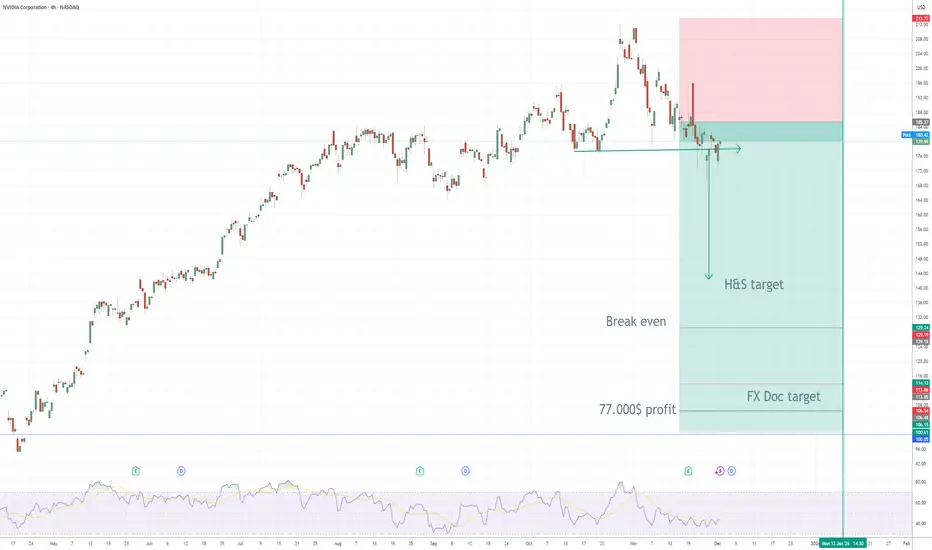
NVIDIA (NVDA) – My PUT Options Position ExplainedI opened a medium-term bearish position on NVDA by purchasing PUT options.
Here’s the full breakdown of the idea, entry logic, and projected targets.
🧠 Why I Entered the Trade
NVDA formed a clear Head & Shoulders (H&S) reversal pattern on the 4H chart — one of the strongest technical reversal signals after an extended bullish trend.
The neckline has now been broken, validating the structure and confirming bearish momentum.
The rejection from the right shoulder, combined with weakening RSI and loss of key market structure, provides additional confirmation.
🎯 My PUT Options Position
I purchased PUT contracts with a defined risk and leveraged downside exposure.
Break-Even Price: ~129 USD
This is the key level where:
the option premium is fully recovered
the position shifts from “loss” to “profit”
As long as NVDA trades below 129 USD before expiration, the position begins generating profit.
💰 Profit Projection
My profit target zone is around 102 USD.
At that level, the trade yields approximately:
➡️ +77,000 USD profit
This aligns with:
the measured target of the Head & Shoulders pattern
previous demand zone turning into resistance
Fibonacci extensions
a full correction of the last impulsive leg
📌 Technical Breakdown
H&S target: ~160 → ~130 → projected extension toward 102
Break-even: 129 USD
FXDoctor target: 102 USD
Trend structure: Major lower lows forming
Momentum: RSI breakdown and bearish continuation signals
The chart clearly shows a potential shift from a hyper-parabolic bullish phase into a deeper correction — a move that benefits PUT buyers with asymmetric risk/reward.
🧨 Summary
I’m holding PUT options on NVDA
Break-even: 129 USD
Projected profit: ~77,000 USD at 102 USD
The trade is based on a clean and validated Head & Shoulders reversal
NVDA is showing early signs of a much larger bearish correction
Mastercard: Further Downside Pressure? Mastercard extended its recent bout of weakness, briefly dipping below support at $527.33 before quickly rebounding. In our primary scenario, we anticipate that the sell-off will continue along magenta wave (4), likely driving price into our green Long Target Zone between $493.51 and $453.69. Alternatively, it’s possible that the turquoise wave alt.2 has already been completed. If so, a direct breakout above $623.64 could occur, which would invalidate our Target Zone (probability: 35%).
$TSLA: $350 Target - $380 Short (Support Breaking)The support for Tesla seems to be breaking, and the oscillators are due for a negative downtrend along with the RSI close being too high. The analysts at the same time are neutral and this has been given a buy over a strong buy target with catalysts like lower earnings in some countries and a lack of competitive advantage over BYD for actual output of vehicles produced and sold. Management is also unsure of Musk who has a huge multitrillion dollar pay package incentive which will make the company even lower on cash. Therefore, the next target for a NASDAQ:TSLA short in my opinion, is $380 or less within Q1 of 2026. As always, none of this is investment or financial advice. Please do your own due diligence and research.
AMD — Trying to Break the 50 MA, but GAP Still DominatesHello Everyone, Followers,
Happy Sunday to all.
I will share today some analysis to follow-up next week. First one is AMD:
AMD continues its battle around a critical technical zone.
After filling the October GAP, the price is now attempting to reclaim the 50-day MA (green line) — a key momentum signal for short-term trend reversals.
🔍 Chart Highlights
- A clear GAP zone from early October still acts as a psychological and technical pivot.
- Price bounced from the lower trendline inside the long-term ascending yellow channel, showing buyers defending this structure.
- The 50 MA is currently pushing down on AMD — reclaiming it would open the door toward 240–250.
- Two potential paths (yellow = bullish continuation, red = deeper retest) show how the price may behave into early 2026.
🔹 Outlook
If AMD closes decisively above the 50 MA, momentum could accelerate toward 236 → 245 → 260 , with the channel midline guiding the move.
If rejected again, a retest of 192–200 remains possible — especially if the market weakens.
🔹 My Plan
I stay patient.
A strong daily close above the 50 MA = bullish signal for me.
If we dip back toward 200–192 , I see it as a long-term accumulation zone.
If bullish signal is confirmed then my final Price Target is 300
If you enjoy and like clean, simple analysis — follow me for more.
This is just my thinking and it is not invesment suggestion , please do not make any decision with my anaylsis.
Have a lovelly Sunday to all and Good Start a Week.
#AMD #SPX500 #NASDAQ
AMZN Weekly Outlook — Contrarian Put Opportunity📊 AMZN Trading Information
AMZN | QuantSignals V3 Weekly | 2025-12-01
🔹 Primary Direction (Weekly): BUY CALLS
Confidence: 58%
Risk Level: High (low confidence + mixed signals)
🔹 Katy AI Direction: BUY PUTS
Predicted Move: -1.38%
Katy Confidence: 50%
⚠️ Directional Conflict Detected
📈 Price + Targets
Current Price: $234.96
Recommended Strike: $230P
Entry: $0.21
Target 1: $0.42
Stop Loss: $0.11
Expiry: 2025-12-05 (4 days)
📉 Market Signals
Weekly Momentum: NEUTRAL (+0.38%)
PCR (Flow Intel): 0.98 (Neutral)
RSI: 70.7 (Overbought — supports downside move)
Resistance: $235.80
VWAP Support: $231.30
🧠 Why Bearish? (Summary)
Katy AI shows 168 prediction points trending downward.
Price near weekly high + overbought RSI → pullback likely.
Put premiums are cheap, giving strong risk/reward.
⚖️ Risk Rating: MODERATE–HIGH
Use small position size due to LLM vs Katy conflict
Nvidia ($NVDA) Stock: $2B Synopsys Deal Expands AI Design PowerNvidia has taken another major step to secure its dominance in AI infrastructure by investing $2 billion in Synopsys, one of the world’s leading chip design software companies. The investment instantly makes Nvidia one of the top shareholders and deepens the long-term collaboration between the two firms. The deal strengthens Nvidia’s control over key parts of the AI value chain, from hardware to software tools used in designing new chips across multiple industries.
This partnership gives Synopsys access to Nvidia’s advanced developer tools and GPU-accelerated libraries to boost its electronic design automation (EDA) processes. These improvements aim to speed up chip development cycles at a time when demand for advanced AI hardware continues to surge. For Nvidia, the move ensures it stays positioned at the center of AI innovation and benefits financially from the growth of the entire ecosystem—not just from selling GPUs.
The timing also matters. Synopsys recently reported weakness in its intellectual property segment due to export restrictions tied to China and slower activity from a major foundry customer. Nvidia’s investment restores confidence in Synopsys' long-term outlook while offering Nvidia a strategic foothold in the tools that design the chips running global AI infrastructure.
Technical Analysis
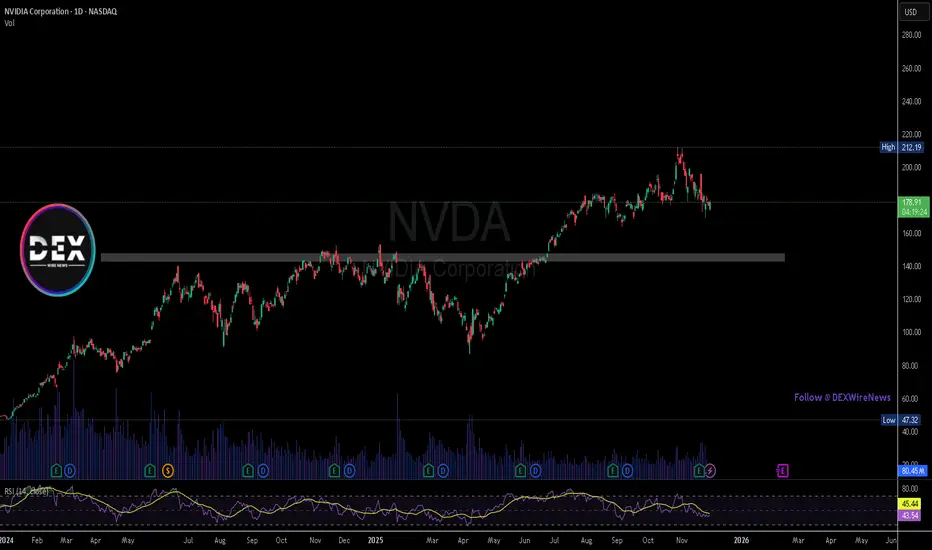
Nvidia’s overall trend remains bullish despite a slight pullback. Price currently trades around $178, holding above a key support zone at $145, which becomes the level to watch if broader tech stocks weaken. Upside momentum resumes if price pushes toward the $212 resistance area—its previous major high. A confirmed breakout above $212 would signal continuation of the broader bullish structure.
With a strong fundamental catalyst and firm long-term trend, Nvidia remains one of the leading names powering AI’s next wave.
NVO long-term TAThere's a good chance that Novo Nordisk will shine again! Technically speaking the volumes and the indicators have not turned bullish yet, but despite of the long downtrend the indicators have been improving for quite some time, weekly accumulation is rising steadily, which signals positive divergence, the current area of $40-45 is good for the support and potential new uptrend in the process. Can it dive even lower? Sure it can but that will push the divergence even higher. In short, keep an eye on NVO.
NVDA long-term TANvidia is still keeping up the long-term uptrend but the mid-term is currently in distribution since the last couple of weeks, so let the news won't surprise you, it's healthy for Nvidia to fall lower and that's what it been doing recently. Some time is needed for Nvidia to bottom out, while long-term remains bullish, the mid-term is yet bearish.
Is Cisco Building the Internet of Tomorrow or Something Else?Cisco Systems has undergone a dramatic transformation in 2025, evolving from a traditional hardware vendor into what the company positions as the architect of secure, AI-driven global infrastructure. With fiscal year 2025 revenue reaching $56.7 billion and a remarkable 30% surge in operating cash flow, Cisco's financial performance tells only part of the story. The company has strategically positioned itself at the intersection of three critical technological timelines: the immediate AI infrastructure boom, the ongoing geopolitical supply chain realignment, and the long-term quantum computing development.
The company's geopolitical strategy has been particularly aggressive. In response to escalating US-China trade tensions and tariffs reaching up to 145% on certain components, Cisco has pivoted its manufacturing operations to India, establishing it as a new global export hub. Simultaneously, the company launched its Sovereign Critical Infrastructure portfolio in Europe, offering air-gapped solutions that address European concerns about digital sovereignty and US extraterritorial reach. These moves position Cisco as the "trusted vendor" for Western alliance infrastructure while monetizing the fragmentation of the global internet.
On the technology front, Cisco has made bold bets on the future. A landmark partnership with IBM aims to build the world's first large-scale quantum network by the early 2030s, with Cisco developing the optical infrastructure to connect quantum processors. The company has also integrated SpaceX's Starlink into its SD-WAN portfolio and participated in NASA's Artemis program. Meanwhile, its AI-native Hypershield security platform, protected by the company's 25,000th patent, and the integration of the Splunk acquisition demonstrate Cisco's push into AI-era cybersecurity.
The convergence of these initiatives reveals a company no longer simply selling networking equipment, but rather positioning itself as essential infrastructure for Western technological sovereignty. With explosive demand from hyperscaler customers generating over $2 billion in AI infrastructure orders and analysts raising price targets amid a 25% stock rally, Cisco appears to have successfully weaponized the geopolitical moment to reinforce its market position for the next generation of computing.